emlocke logo with teal letter 'k'
  • Nostalgia will bring you to your knees in the snow

    If my spirit starts to wane on Christmas Eve Eve, The Snowman, British illustrator Raymond Briggs’ wordless Christmas epic, is the only thing that can save me.

    thesnowman_briggs.jpg

    The picturebook was originally published in 1978 (by Random House in the U.S.) and the animated adaptation first aired on Christmas Eve in 1982 (here is the best scene on YouTube), and the artistry, the accompanying score (composed by Howard Blake), and the story still charm me.

    The tale includes a ride on a retro motorcycle, a visit to the North Pole, a penguin encounter, a cruise ship full of “revelers” drunk on champagne and holiday cheer, childlike humor and an enchanted friendship. The conclusion uses one of my favorite children’s story plot devices: a physical article left behind to prove that the magic is real, not just a dream.

    I really love the Snowman—this particular Snowman—for his roundness. His disproportionate limbs, the inelegant brim of his hat, even his nose. We have a stuffed Snowman that winds up and plays Blake’s Walking in the Air. When the music box starts to wind down, the melody creeps tenderly along to its ending. I know it’s just mechanics, but the effect is perfect.

    I’m holding very tight
    I’m riding in the midnight blue
    I’m finding I can fly so high above with you

    —Howard Blake, Walking in the Air

  • Constance

    I don’t really know what to make of it, though it was so odd that there must be something to be made. It was Wednesday. It was mid-morning. And it was on the subway.

    I was riding the F. I had all my bags in my lap and a New Yorker in one hand and in the other, a travel cup full of coffee that was burning the undersides of all my fingers. I was sitting in a seat on the end of a bench, by one of the doors, the one everybody wants.

    The pages of my magazine were coiled around the spine and I was holding it upright but blatantly, as in not even pretending, not reading it. And that’s why I noticed when Constance came lumbering down the car. She tossed her tote bag on to the pair of seats that face the front of the train and then crashed herself into an empty seat-and-a-half on the opposite side of the train.

    The weary haze across her eyes seemed a veil between her and the other passengers, but it took just a few moments for her to focus in on a guy sitting near by. Her expression sharpened and she shot forward in her seat and implored him to “listen, listen to me. Listen to what I’m saying.”

    Constance rides the F a lot. Constance isn’t her name. It would be a mind-blowing coincidence if it were, anyway.

    (more…)

  • This movie is a wish my heart made

    On Thursday night, I got an e-mail from someone at work that said, “I’ll take care of this tomorrow because you’re out, right?” I wrote back, “thanks for making that call, and for reminding me that I have the day off!” On Friday, I took myself to see Enchanted, a movie about a kind-hearted, red-headed Princess who lands in Manhattan, frolics in Central Park, loses a shoe, and falls in true love.

    I hardly ever go to the movies.  And I’ve never ever gone alone before.  But I couldn’t wait to see my own life story on the big screen.

    My favorite part was the Central Park extravaganza. Disney took a brief pause from poking fun at itself and poked some at New York—the bicyclists, the elderly bench gents, and the city park matrimonies.

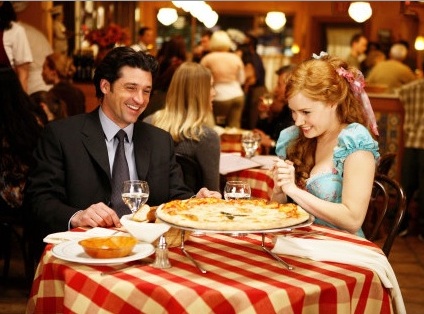
    I also loved the pizza parlour scene, a finespun reference to Lady and the Tramp, but mostly because I wish I could dress like this every time I go out. Seriously, Princesses have it easy. It can’t possibly be difficult to pick out an outfit when your choices are all gowns. If I wore this teal dress around the corner to get a slice, people would point and stare and be all “check out the crazy girl.” Giselle made her dress out of Patrick Dempsey’s curtains and even so, he’s staring in a good way.

    enchanted_pizza.jpg

    I think they’re both crazy in a good way.

    It will be fun to re-watch Enchanted because of Disney’s postmodern self-references. Touches like a rose under a bell jar in cartoon-Giselle’s room and the production of Rapunzel that Giselle interrupts in Central Park made me feel like I was seeing more than one movie at once. And since I see movies so very, very rarely, it’s important that I get as much as possible out of those theater trips.

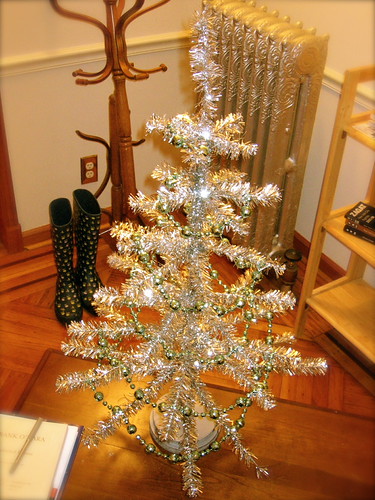
  • Tinsel, like many conifers, has its own distinctive fragrance

    .flickr-photo { border: solid 2px #000000; } .flickr-yourcomment { } .flickr-frame { text-align: left; padding: 3px; } .flickr-caption { font-size: 0.8em; margin-top: 0px; }


    If you’re going to have an artificial tree for Christmas this year, at least have one that is absolutely authentic in its artificiality.

  • Let me start by cleaning the torn Splenda packets out of my bag

    People are talking about Found Objects, the short fiction piece in today’s New Yorker. The accompanying artwork is what captured my attention. In print, the photo is large. The scattered objects are almost life size and tactually inviting on the page. The primary color scheme is reassuring. It’s an ill-lit still life of what might be the contents of a junk drawer.

    Turns out, it’s the contents of one of the tables on which Sasha keeps, stores, displays the belongings that she has stolen from someone else and taken home with her for keeps.

    Sasha is, in what might as well be sitcom terminology, a kleptomaniac. Her disorder is often misunderstood because, unlike compulsive hair plucking or step-counting or cleaning, the percieved payoff seems obvious. Sasha isn’t interested in the monetary value or even the sentimental value associated with the objects that she takes. She’s only concerned with the taking.

    Sasha thinks she wants to stop, so she’s seeing a therapist to help her get well. It seems like the thing to do, but it’s hard, because without her objects, what will she have? Without her collection, what will she do? Without her compulsion, who will she be? She’s got to have something and this is all she’s got.

    The objects themselves, on private exhibit atop two tables in Sasha’s apartment, hold only souvenir appeal. They are trinkets that represent the moment of possession. So while there are, of course, wallets among her collection, they have not been plundered. Sasha tells her therapist about lifting a wallet straight from another woman’s handbag. Its shape and density catch her eye; its proximity tempts her hand. Its foreign presence in her own handbag lifts her spirit. She never even unfolds the other woman’s wallet.

    To Sasha, the wallets are “embarrassments and close shaves and little triumphs and moments of pure exhilaration.” The contents are irrelevant. They might as well be a screwdriver or a bar of soap or a child’s scarf or a stout pen or a mechanical pencil.

    A wallet is just a thing that gets stolen. The same way a newspaper gets swatted at a fly and a marble gets shot across a ring on blacktop. In a way, Sasha takes Alex’s wallet because she’s supposed to.

    The slip of paper that she finds inside, the one with “I BELIEVE IN YOU” handwritten on it, doesn’t mean anything to her. She wants it to. She knows it could. It’s supposed to make her feel something besides the thrill of simply having it.

    That scrap of paper embodies every thing I have or do or say because I’m supposed to or because I might as well or because it seems like the thing to do. The things we hold on to just to have something, even a collection of bookmarks and stopgaps. I want to sweep it all of the table. But then, the mess. And I don’t want to break anything.

  • Twelve Christmas songs that don’t make me want to set the tree on fire

    One Christmas, I woke up with an Alvin and the Chipmunks Christmas cassette tape under my pillow a few weeks before Christmas. Santa dropped in early with the surprise so I could enjoy it during the holiday anticipation. I really hoped that would become a tradition—not only because I liked having the preview present to tide me over, but also because the music put me in touch with my Christmas spirit.

    I don’t think Santa made any more early rounds to our house, but in the last couple of years, I’ve made a point to start playing Christmas music throughout the month of December.

    I really like classical pieces and avoid anything that references directly: jingling, jollyness, or any gathering of one or more of a single type of bird in the same tree. Here are some favorites:

    God Rest Ye, Merry Gentlemen
    The Barenaked Ladies with Sarah McLachlan
    Barenaked for the Holidays

    The arrangement and the harmonies are flawless. Sarah is Sarah and BNL is BNL. Together, their sound is tender, jovial and bright. It’s like listening to a folk tale.

    The First Noel/Mary, Mary
    Sarah McLachlan
    Wintersong

    A mesmerizing rendition of a traditional carol. The classic verses have a drum-driven, new age sound that conjures an image of angels as divine apparitions. Verses of Mary, Mary, a sensual spiritual about mother and child, ground the track. There is something absolutely earthly about these interludes. That mortal emotion is lacking from most classical Christmas music.

    Maybe This Christmas
    Ron Sexsmith
    Maybe This Christmas

    If you’ve ever had a Christmas wish for something that wouldn’t fit under the tree, you’ll appreciate this song. World peace? Maybe, just maybe.

    What Child Is This/Greensleeves
    Charlotte Church
    Dream a Dream

    I do not know how a song about a promiscuous renaissance woman with sleeves stained from rolling around in the grass evolved into a Christmas carol, but it is one of my favorites. Charlotte Church is both angelic and mournful.

    Christmas Eve/Sarajevo 12/24
    The Trans-Siberian Orchestra
    Christmas Eve and Other Stories

    The TSO turned the true story of one intensely passionate Bosnian cellist, who is said to have played Christmas music amid the violent siege in Sarajevo, into an intensely passionate orchestral piece. In the “symphonic metal” genre, the classical elements are strong, but the rock elements are fierce. This explosive piece sounds like anticipation—of Christmas Day and of peace.

    Joy of Man’s Desire/Angels We Have Heard On High
    The Trans-Siberian Orchestra
    The Christmas Attic

    Joy of Man’s Desire has been put to good use. Since childhood, this has been one of my favorite Christmas hymns because it’s relatively easy to keep up with the verses and if you get lost reading the music, you can always catch up on the “glo-o-o-o-o-o-ria.”

    Christmas Canon
    The Trans-Siberian Orchestra
    The Christmas Attic

    A palpable element of childlike wonderment. There is also a “rock” version with a little more edge—maybe for the jaded who still secretly believe in Christmas miracles.

    Have Yourself A Merry Little Christmas
    Sister Hazel
    Santa’s Playlist

    Hits the perfect note—a little melancholy, but still hopeful. There’s something sort of Simon and Garfunkel about the harmony. It reminds me of Homeward Bound and this rendition evokes a similar sentiment.

    Wintersong
    Sarah McLachlan
    Wintersong

    “Merry Christmas, my love,” has never been wished with such heartbreak. The delicate piano and wistful lyrics are reminiscent of silent snow falling on an empty wood—lonely, but lovely.

    White Christmas
    Ella Fitzgerald
    Ella Wishes You A Swinging Christmas

    Ella’s White Christmas—much more than Sinatra’s or Bing Crosby’s—carries the promise of snow. Not even the swaying warmth of her tone could stop it. Her dream is going to come true.

    The Coventry Carol
    Alison Moyet
    A Very Special Christmas, Vol. 1

    Conveys, in a way that most versions do not, the frantic distress of mothers when King Herod orders that all the infant boys in Bethlehem be killed. Haunting.

    O Holy Night
    Tracy Chapman
    A Very Special Christmas, Vol. 3

    There are, of course, many more traditional versions of this hymn, but Tracy Chapman’s gentle, reverent interpretation is earnestly divine.

    That’s twelve—one for each day of Christmas!

  • Regardless, I’d rather ride the subway

    The first time I saw one of NYC’s Garden in Transit cabs, it was about to run me down. I got a good look at the floral decals across the hood and the top of the trunk. I assumed the car belonged to a free spirited driver trying rail against convention, stand out from the rest of the fleet.  But I wondered whether one should be drawing attention while running red lights so boldly.

    The next time, I was riding in the car with my mom; she was driving me back to Brooklyn after a weekend at home. I was scanning the curb for a free parking space when it caught my eye, and it didn’t even occur to me that it might be a doppelganger. “That’s the cab that almost hit me last week! Waaait a minute . . . ” My mom said, “I thought you were looking for a place to park.” I put the stalker-taxi in the back of my mind.

    The next day, Manhattan was covered with neon flowers. I guess that ‘one’ blooming taxi cab wasn’t following me around Brooklyn after all.

    But if this cab were stalking me, that would explain why it was parked right outside my building on Sunday morning.

    The vinyl flower outlines have been completely removed from the hood and the patterns on the back are almost scraped off. It’s too bad that the same can’t be said for the new NYC Taxi logo.

    There’s a video that shows the decal application process on the Portraits of Hope organization website. There is no demonstration of the removal process, though, and according the FAQ‘s, cab drivers who participated in the project are responsible for deflowering their own vehicles.

  • I like buildings that look like buildings

    A few years ago, the City of New York mandated that all buildings of a certain age and of stone construction be entirely repointed. Manually, the process involves cutting each stone in a building’s facade out of its mortar setting, repositioning it, and securing it. By the time the project is complete, every stone has been touched. By continuous degrees, the building has been taken apart and put back together, with little perceptible change.

    The purpose of repointing is actually to repair or strengthen the mortar joints between stones, or bricks, which wear down, crack and crumble over time, and not the stones themselves. But the term ‘repoint’ lends itself to a different concept in my imagination: I picture building blocks rotating in place, like cubical beads on a 21-story abacus, so that a new side of every stone faces out. Imagine a time-lapse video of a building being repointed, fresh stone faces appearing row by row, as though a curtain were being drawn aside.

    That’s one thing about architectural restoration and building projects—their large scales and lengthy timetables aren’t often conducive to the big reveal. Take the new New Museum, which came out to society on Friday. It graced the pages of nearly every print publication, but the big moment was a bit of a letdown. The museum’s new doors wouldn’t open until Saturday, December 1st, so the publicity was weighed down by hesitation, sort of like hosting a party over the weekend when your birthday falls on a Wednesday.

    On top of that, the building’s appearance came as no surprise to anyone who has wandered by the construction site since the project was commissioned in 2002. There was no curtain to draw back, no veil to whip off before a gasping audience. However, there is a time-lapse video of the ongoing construction on The New Museum’s website (note the :20-:30 second mark when the white tarps hung across the work area hint at the finished look).

    Architecture as art is multi-faceted in a maddening way. Whenever I try to turn it over in my head, I fall on the same conclusion: I think of it as sculpture slash ongoing installation slash performance piece. Like a vessel, life goes on inside while a traditional masonry building (a building that looks like a building) is repointed. The New Museum, that tottering chainmail edifice on the Bowery, will begin to turn the spotlight over to guests in its galleries. Inside, change will be continuous, deliberate, anticipated, sensational. Patrons will push through the doors to see what’s behind the industrial mesh curtain.

  • After a year of all this

    It was a year ago today that I spent my first night in my first apartment in New York City. In honor of my first anniversary, I’m answering New York magazine’s 21 Questions. Who do I think I am? A New Yorker? Next it’ll be the Proust Questionnaire.

    Who: Emily [Locke]
    Job: Academic Marketing Assistant
    Age: 23
    Neighborhood: P. Slope

    Who’s your favorite New Yorker, living or dead, real or fictional?
    Eloise of The Plaza Hotel. Or Jacqueline Kennedy Onassis. Or Javier from Felicity.

    What’s the best meal you’ve eaten in New York?
    Waz-Za? at Norma’s in le Parker Meridien.

    In one sentence, what do you actually do all day in your job?
    I sit in my giant office pushing fiction and nonfiction on college professors and drinking Diet Coke.

    Where do you get your coffee?
    Where don’t I get my coffee?

    What’s the last thing you saw on Broadway?
    Off-Broadway is where it’s at. Peter and Jerry.

    Do you give money to panhandlers?
    I do and I don’t. I don’t really have a policy.

    What’s your drink?
    Vodka and Diet Coke.

    How often do you prepare your own meals?
    Define ‘prepare.’ Actually, define ‘meal.’

    What’s your favorite medication?
    Bed rest.

    What’s hanging above your sofa?
    A philistine poster of Times Square. It is so tacky.

    How much is too much to spend on a haircut?
    Anything more than like, $80 is truly outrageous, but I spend more anyway.

    When’s bedtime?
    At some point between a Sex and the City rerun and sunrise, depending on the day.

    Brunch. Pro or con?
    Con. I just don’t think we should be ashamed to call it breakfast even when we eat it at noon.

    What’s your thread count?
    300.

    What do you hate most about living in New York?
    It’s a toss up between how big the city is and how small the city is.

    What’s your brand of jeans?
    J. Crew.

    When’s the last time you drove a car?
    Thanksgiving break.

    Who should be the next president?
    Eloise of the Plaza Hotel. Seriously.

    Times, Post or Daily News?
    New York Times dot com.

    Yankees or Mets?
    The Yan—wait. Is it totally for sure that The Dodgers aren’t coming back to Brooklyn?

    What makes someone a New Yorker?
    Every New Yorker should have somebody to watch their back (and somebody’s back to watch) and a passion for something that they consider artful.

  • On a pillow toss and a promise on which I have to make good

    Chelsea and Jim are on opposite ends of the sofa with their stocking feet mixing together in the middle, but closer to her side because he’s got longer legs and she’s wearing a skirt. Floral-print pillows sail between them every few moments. Mostly from Jim’s side because Chelsea is lazily passing them over to him to lob back at her.

    It’s getting late and we’ve been teasing and nagging each other for ages, treading lightheartedness. We’re all grinning placidly, appreciating the company.

    I accuse them of flirting for a few reasons. Mostly because I’m feeling left out. Chelsea doesn’t even raise her voice in dissent, that’s how preposterous the idea is. Unruffled, still mostly concentrating on the pillow exchange, she informs me that to flirt with Jim would be incestuous. Because he’s like her brother.

    And that gets a whole something else going.

    “Except I don’t have a brother. So how can he be like my brother? The brother that I don’t have?” I try to shrug and shake my head to deflect and pretend I never said anything, but my shoulders are lost in the extra space inside my jacket and the arm of my chair is digging into my temple, preventing any appreciable gesture. I have my eyes closed now and I’m just thinking that I don’t know ‘how’ and she’s the one who said it, so.

    Her not-brother asks what she’s talking about and Chelsea tries to rephrase the logic. “If you’re like my brother, but you’re not my brother . . . because I’m an only child . . . I don’t have a brother so how can I know what having a brother is like?”  Jim ohhh-kays her and launches another pillow and they forget about it.

    I think about it for a long time.

    I sit there feeling cheated, somehow. It’s a little like remembering suddenly that there’s some place else I’m supposed to be. I remember the promise to myself that I would to stop needing to be everything to everyone. Needing and wanting are just two different promises.